






Discover the essentials of value proposition vs mission statement, learn key differences, and get a free AI template to craft both clearly and effectively.
The difference between value proposition vs mission statement comes down to purpose: a value proposition explains why a customer should choose you, while a mission statement explains why your company exists in the first place. Both documents guide business decisions, but they answer different questions and serve different audiences. Getting this distinction right matters more than it might seem at first glance, because messaging built on a confused foundation tends to confuse everyone who encounters it, from customers scanning a landing page to new hires trying to understand what the company actually stands for.
Many teams blend these statements together, which creates confusing messaging that fails to resonate with customers or employees. A founder might write a single paragraph intended to do the job of four separate documents, and the result satisfies none of the audiences it was meant to reach. This article breaks down the distinctions clearly, shows you how they relate to vision and value statements, and gives you a practical AI template to draft all of them with consistency. By the end, you should be able to look at any piece of company messaging and immediately identify whether it is functioning as a mission statement, a vision statement, a value statement, or a value proposition, and whether it is doing that job well.
Value Proposition vs Mission Statement: The Core Distinction
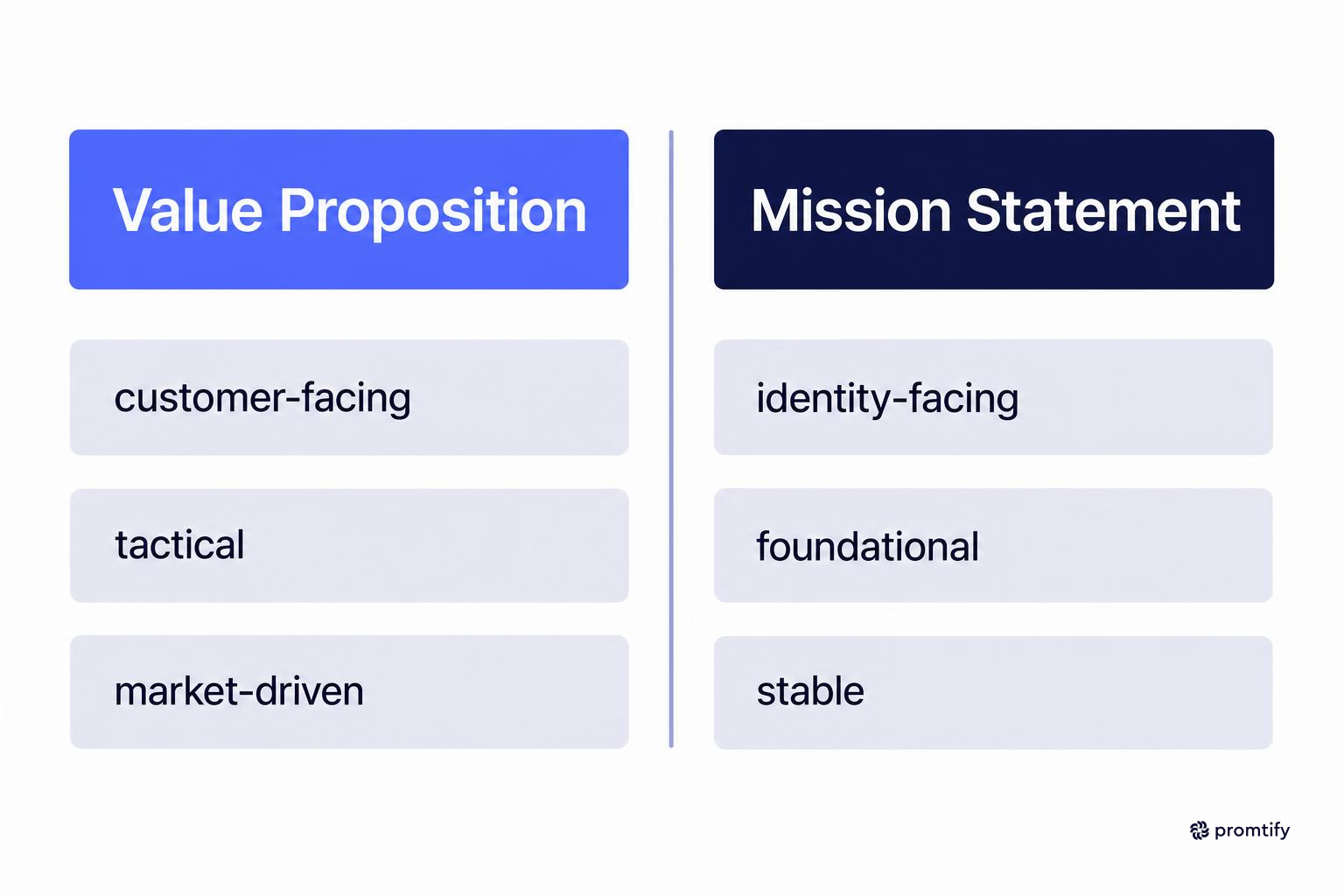
A value proposition is a customer-facing statement that explains the specific benefit someone receives by choosing your product or service over alternatives. It answers the question "why should I buy from you instead of a competitor?" This statement lives in the world of commerce. It shows up on pricing pages, in sales decks, in the first line of an ad, and in the opening seconds of a sales call. Its entire job is to make a prospective buyer understand, quickly and specifically, what they stand to gain.
A mission statement, on the other hand, describes the fundamental purpose of your organization. It answers the question "why does this company exist, and what are we trying to achieve?" This statement lives in the world of identity. It shows up in founding documents, in onboarding materials, in investor decks under the "about us" slide, and often in the company handbook. Its job is not to persuade a customer to buy anything, but to anchor everyone inside and around the organization to a shared sense of purpose.
The value proposition is tactical and market-facing. The mission statement is foundational and often internal, guiding culture, hiring, and long-term strategy. You can change a value proposition as your market shifts, but a mission statement usually stays stable for years. Consider a software company that originally built its value proposition around speed of onboarding. If a competitor enters the market with an even faster onboarding flow, the original company might need to rewrite its value proposition to emphasize a different angle, such as integration depth or customer support quality. Its mission statement, something like "to make complex software accessible to non-technical teams," does not need to change at all because the underlying purpose of the business has not shifted, only the tactical message used to sell it.
This distinction becomes especially important during moments of competitive pressure. When a competitor launches a feature that undercuts your current value proposition, the instinct is often to panic and rewrite everything, including the mission statement. Resist that urge. The mission statement should only change when the fundamental reason your company exists has changed, not when a single market condition shifts. Confusing a tactical adjustment with a foundational one leads to constant rewriting of documents that should otherwise provide stability.
- Value proposition: Focuses on customer benefit and competitive differentiation.
- Mission statement: Focuses on organizational purpose and reason for existing.
- Audience: Value propositions target customers and prospects; mission statements target employees, investors, and the public.
- Timeframe: Value propositions adapt with market conditions; mission statements remain largely fixed.
Another useful way to separate the two is to think about what happens if you removed the company name from each statement. A well-written value proposition will often still make sense without the brand name attached, because it describes a benefit a customer receives, not a company identity. A mission statement, by contrast, is inherently tied to the organization making the claim. It would feel strange for two unrelated companies to use the exact same mission statement, because the mission is supposed to reflect something specific about why that particular organization was founded.
Why Teams Confuse These Two Statements
Confusion happens because both statements often appear on the same page, such as a homepage or an "About Us" section. When a mission statement and value proposition sit next to each other, readers assume they serve the same function. A visitor scrolling through a homepage does not pause to categorize each sentence into "mission" or "value proposition" buckets. They simply absorb the overall impression, which means that if the two statements are not clearly distinct in tone and intent, the messaging blurs together into a vague, undifferentiated paragraph.
Another source of confusion is that both statements can sound aspirational. A mission statement might say "we help businesses grow," and a value proposition might say "we help you grow revenue faster." The overlap in language masks the fact that one is about company purpose and the other is about customer outcome. The word "grow" appears in both, the tone is similarly upbeat, and the sentence structure is nearly identical. Without careful attention to what each statement is actually trying to accomplish, writers naturally gravitate toward similar phrasing, which compounds the confusion rather than resolving it.
This problem is made worse when companies hire outside copywriters or agencies without giving them a clear brief on which statement they are being asked to write. An agency tasked with "refreshing the brand messaging" might produce a single polished paragraph that tries to do everything at once: explain the company's purpose, describe its future vision, list its values, and pitch its product, all within three or four sentences. The result reads smoothly but fails every individual test. It does not clearly explain why the company exists, it does not give employees a rallying purpose, and it does not give customers a specific reason to buy. Separating these functions from the start, even during the briefing stage of a project, prevents this blending from happening.
If you want a side-by-side breakdown of how these statements differ in structure and intent, see this guide on mission statement vs value proposition, which walks through practical examples.
Mission Statement vs Value Statement: Another Common Mix-Up
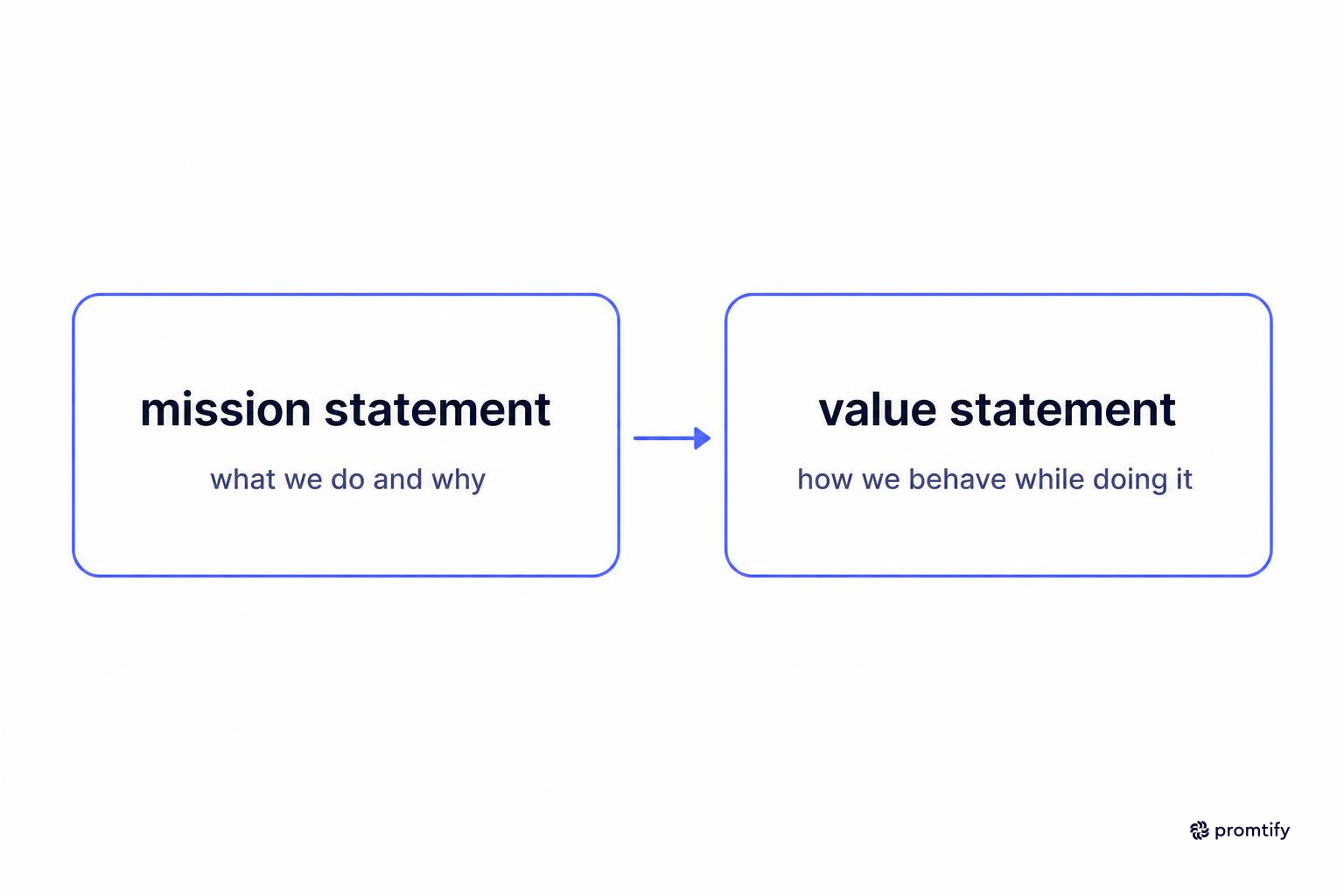
A value statement is different from both a mission statement and a value proposition. A value statement lists the principles or ethics that guide how your organization behaves, such as honesty, accountability, or sustainability. Where a mission statement is a single, unified sentence or short paragraph describing purpose, a value statement is typically a list, often three to five items, each representing a behavioral commitment the organization holds itself to.
While a mission statement explains what your company does and why, a value statement explains how your company behaves while doing it. For example, a mission statement might be "to make financial planning accessible to everyone," while a value statement might include principles like "transparency" and "customer-first service." Notice that the value statement items do not describe what the company sells or who it serves; they describe the character of the organization as it goes about its work.
The distinction matters because value statements shape internal culture and decision-making, not external market positioning. A value proposition speaks to customers about benefits, a mission statement speaks to stakeholders about purpose, and a value statement speaks to employees about conduct. When a manager is deciding how to handle a difficult customer situation, the mission statement will not tell them what to do, but a value statement that emphasizes "customer-first service" gives them a concrete principle to apply. This is why value statements often show up in employee handbooks, performance review criteria, and internal training materials rather than on public-facing marketing pages.
A practical test for whether something is functioning as a value statement rather than a mission statement is to ask whether it could apply to a company in a completely different industry. A value like "transparency" could guide a financial planning company, a software company, or a restaurant chain equally well, because it describes behavior rather than purpose. A mission statement, by contrast, is tightly bound to the specific problem the company solves and would not transfer cleanly to an unrelated industry. If your value statement items feel so specific that they only make sense for your exact business model, you may actually be writing a disguised mission statement rather than a true value statement.
Mission Statement vs Vision Statement vs Value Statement
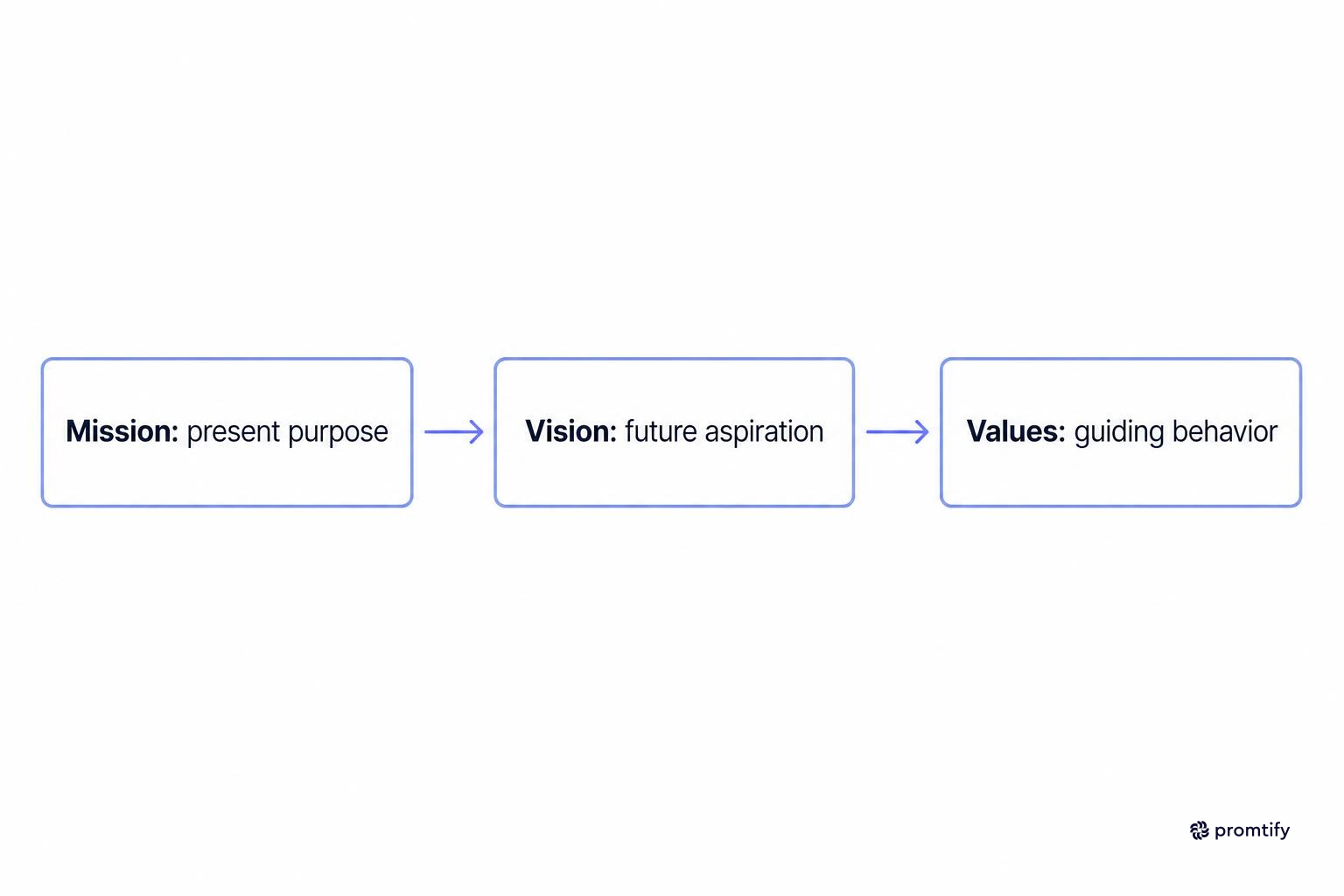
These three statements work together but each has a distinct role. A mission statement describes the present purpose of your organization. A vision statement describes the future state your organization is working toward. A value statement describes the principles that guide behavior along the way. Together, they form a kind of internal compass: the mission tells you where you are and why you are here, the vision tells you where you are trying to go, and the values tell you how to conduct yourself on the journey.
How Vision Statements Function
An operation's vision statement serves to communicate the long-term aspiration of the organization, giving employees and stakeholders a picture of what success looks like years into the future. Unlike a mission statement, which is grounded in the present, a vision statement is forward-looking and often more abstract. It is less concerned with describing current operations and more concerned with painting a picture of an ultimate outcome, one that may take a decade or more to fully realize, if it is ever fully realized at all.
For example, a mission statement might read "we provide affordable renewable energy solutions," while the related vision statement might read "a world powered entirely by clean energy." The mission describes current action, and the vision describes the ultimate goal. Notice the shift in scope and grammar: the mission uses active, present-tense language describing what the company does today, while the vision uses a more expansive, almost imagined future state that the company's daily work is meant to contribute toward, even if no single company could achieve that outcome alone.
This scope difference is intentional and useful. A vision statement that is too narrow or too achievable in the short term fails to inspire long-term thinking, because employees will quickly reach the goal and then feel directionless. A vision statement that describes a genuinely ambitious future state gives the organization decades of runway to work toward, even as specific strategies and tactics change along the way. This is why vision statements tend to use broad, almost utopian language, while mission statements stay grounded and specific about current activity.
Putting the Three Together
When you combine mission, vision, and value statements, you get a complete picture of organizational identity: what you do now, where you are headed, and how you behave while getting there. None of these statements should mention pricing, features, or competitive comparisons, which is the job of the value proposition. If any of these three statements starts referencing specific product features or market comparisons, it has drifted out of its intended lane and started doing the job of the value proposition instead.
A useful check when reviewing these three statements together is to read them in sequence and ask whether they tell a coherent story. The mission should logically lead toward the vision, and the values should feel like a natural constraint on how the company pursues both. If the vision statement describes a future that seems disconnected from the mission's present-day purpose, or if the value statement lists principles that do not seem to matter for achieving either the mission or the vision, something in the trio needs revision. These three documents are meant to reinforce one another, not exist as isolated, unrelated pieces of copy.
Where the Value Proposition Fits Into This Framework
The value proposition sits outside the mission, vision, and value statement trio because it is customer-facing rather than identity-facing. It typically appears on landing pages, sales materials, and product descriptions rather than in a company handbook or annual report. While the other three statements are largely about who the company is, the value proposition is about what the customer gets, and it needs to be understood in seconds by someone who has never heard of the company before.
A strong value proposition answers three questions directly: what does the customer get, how is it different from alternatives, and why should they believe it. This is a narrower and more tactical statement than a mission statement, which explains organizational purpose without referencing any specific product or competitor. A value proposition that fails to answer any one of these three questions tends to underperform, even if the writing itself is polished. A statement that clearly explains the benefit but never addresses why it is different from alternatives leaves the prospect wondering why they shouldn't just buy from a competitor instead. A statement that explains differentiation but gives no reason to believe the claim leaves the prospect skeptical, especially in markets full of bold, unsubstantiated promises.
Because the value proposition carries this heavier burden of proof, it often benefits from concrete, specific language rather than the more abstract phrasing used in mission or vision statements. Numbers, timeframes, and named outcomes tend to perform better in a value proposition than vague claims about quality or excellence, precisely because the audience reading it is in evaluation mode, actively comparing your offer against alternatives, rather than trying to understand your organizational philosophy.
If you are trying to sharpen how your value proposition stands apart from competitors, review this resource on value proposition differentiation for practical framing techniques.
Practical Examples Comparing Each Statement Type
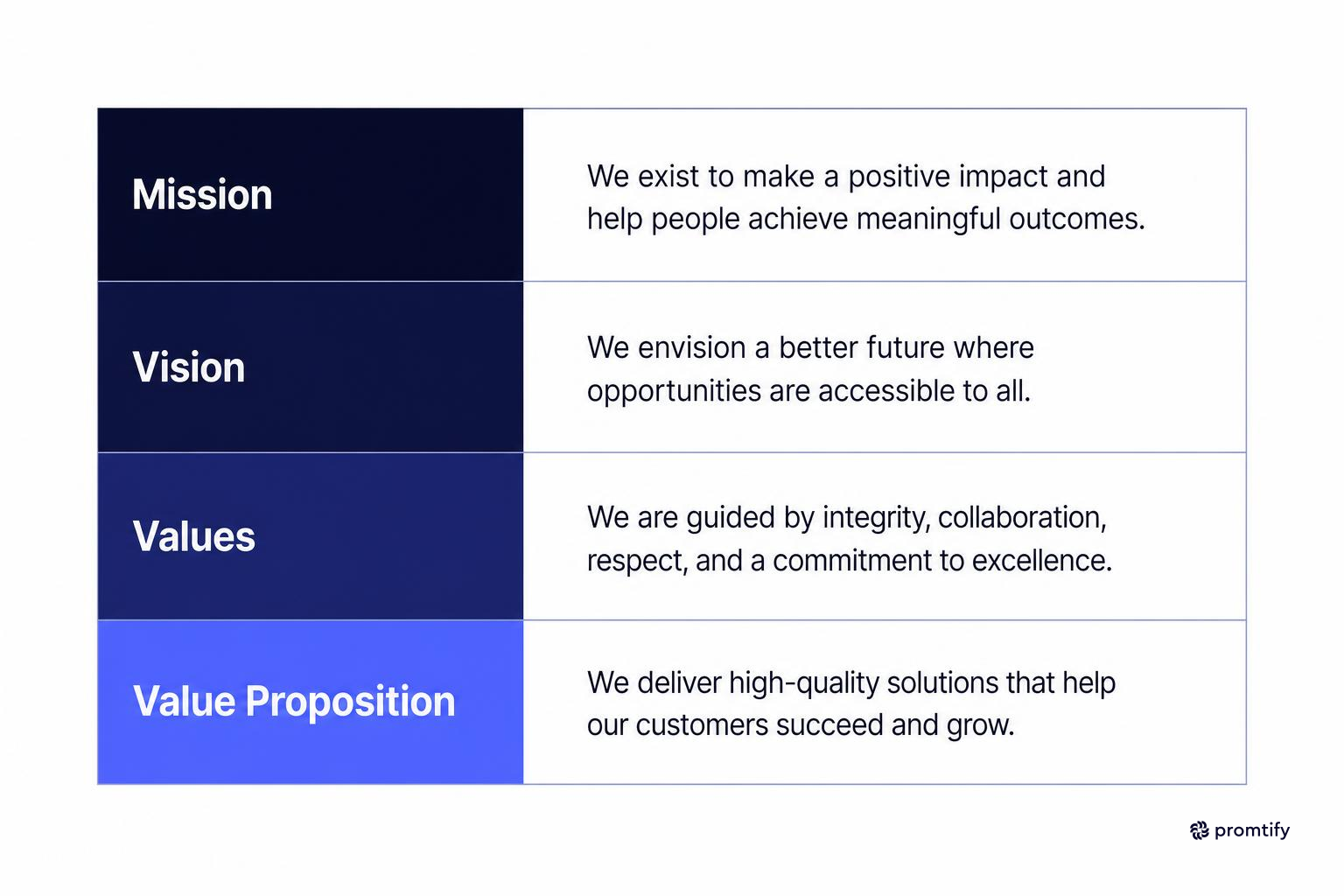
Seeing these statements side by side for the same company makes the differences concrete.
- Mission statement: "To simplify small business accounting through accessible software."
- Vision statement: "A future where every small business owner has complete financial clarity."
- Value statement: "We value simplicity, transparency, and customer trust in everything we build."
- Value proposition: "Automate your bookkeeping in minutes, not hours, with software built for non-accountants."
Notice how the value proposition is the only statement that mentions a specific customer outcome and time-based benefit. The other three statements describe identity, aspiration, and principle rather than a direct customer promise. Also notice how each statement, while related to the others, could not simply be swapped in for another without losing something essential. If you replaced the mission statement with the vision statement, you would lose the grounded, present-tense description of what the company actually does today. If you replaced the value proposition with the mission statement, a prospective customer reading the landing page would learn why the company exists but would have no specific reason to choose this product over a competing one.
This example also illustrates how consistent language can tie the four statements together without making them redundant. Notice that "simplicity" appears in both the mission statement and the value statement, and the theme of accessibility for non-experts threads through the mission, the vision, and the value proposition. This kind of thematic consistency, rather than literal repetition of phrases, is what makes a set of four statements feel like they belong to the same company without collapsing into a single undifferentiated paragraph.
Common Mistakes When Writing These Statements
Many businesses write a mission statement that sounds like a slogan, which blurs it with a value proposition. A mission statement should describe purpose in plain language, not try to sell anything. A telltale sign of this mistake is a mission statement that could double as a tagline on an advertisement, often because it uses punchy, persuasive language rather than descriptive, purpose-driven language.
Another mistake is writing a value proposition so broad that it could apply to any competitor in the market. If your value proposition could be copied word for word by a rival company, it is not specific enough to differentiate you. Phrases like "quality service" or "innovative solutions" fall into this trap constantly, because nearly every company in every industry could make the same claim without changing a single word. A useful exercise is to imagine your closest competitor reading your value proposition aloud as if it were their own. If it sounds equally plausible coming from them, it needs to be rewritten with more specific, defensible language.
A third mistake is treating the vision statement as optional or interchangeable with the mission statement. An operation's vision statement serves to communicate long-term direction, and skipping it leaves employees without a clear sense of where the company is heading beyond daily operations. Companies that only have a mission statement, without any accompanying vision, often find that employees understand what the company does but have no sense of what the company is building toward, which can make long-term strategic decisions feel arbitrary or disconnected from a larger purpose.
A fourth, related mistake is writing value statement items that are so generic they could belong to literally any organization in any industry, which strips them of any practical use for decision-making. A list that simply says "integrity, excellence, teamwork" without further context or explanation gives employees nothing concrete to apply when facing an actual decision. The most useful value statements pair the principle with a brief explanation of what it looks like in practice, so that the value becomes a usable decision-making tool rather than a decorative word on a poster.
- Mistake: Writing a mission statement that reads like marketing copy.
- Mistake: Creating a value proposition that lacks specific, measurable benefits.
- Mistake: Treating vision and mission statements as the same document.
- Mistake: Letting the value statement list generic terms like "integrity" without context.
How Positioning Relates to the Value Proposition
Positioning and value proposition are closely related but not identical. Positioning describes where your product sits in the market relative to competitors, while the value proposition is the specific promise you communicate to customers based on that position. Positioning is often an internal strategic exercise, mapping your product against competitors along dimensions like price, quality, or target segment, while the value proposition is the external, customer-facing expression of where that positioning places you.
Think of positioning as the strategic decision about where you want to stand in the market, and the value proposition as the sentence you say out loud to communicate that standing to a prospective buyer. A company might position itself as the premium, high-touch option in its category, and its value proposition would then reflect that positioning through language emphasizing exclusivity, personalized service, or superior craftsmanship rather than speed or low cost.
For a deeper look at how these two concepts work together without overlapping with mission or vision statements, see this guide on positioning vs value proposition.
How Competitive Advantage Differs From Value Proposition
A competitive advantage is an internal capability, such as proprietary technology or a unique supply chain, that allows you to outperform rivals. A value proposition is the external message that communicates the benefit of that advantage to customers. The competitive advantage can exist quietly behind the scenes, inside engineering decisions or supplier contracts, while the value proposition is the public-facing translation of why that advantage actually matters to the person being asked to pay for it.
Confusing the two often leads companies to describe internal strengths in customer-facing materials without translating them into a clear benefit. A company might proudly state that it uses a proprietary algorithm, assuming that the technical sophistication alone will impress customers, without ever explaining what that algorithm actually means for the person using the product, such as faster results or more accurate recommendations. The competitive advantage is real, but it has not yet been converted into a value proposition a customer can actually use to make a decision.
If you want to understand how to turn an internal advantage into an external promise, review this comparison of competitive advantage and value proposition.
Alternative Terms Used for Value Proposition
Some teams use different terminology for the value proposition depending on industry or audience, such as "unique selling proposition" or "customer value statement." These terms generally point to the same concept: a clear, specific reason for customers to choose you. The variation in terminology often comes down to historical convention within an industry rather than any meaningful difference in function, though some teams do draw subtle distinctions between these terms based on how narrowly or broadly they define the customer benefit being communicated.
If your team is deciding on terminology for internal documents or sales enablement material, this resource on alternative terms for value proposition outlines common variations and when each one fits best.
Step-by-Step Process for Drafting All Four Statements
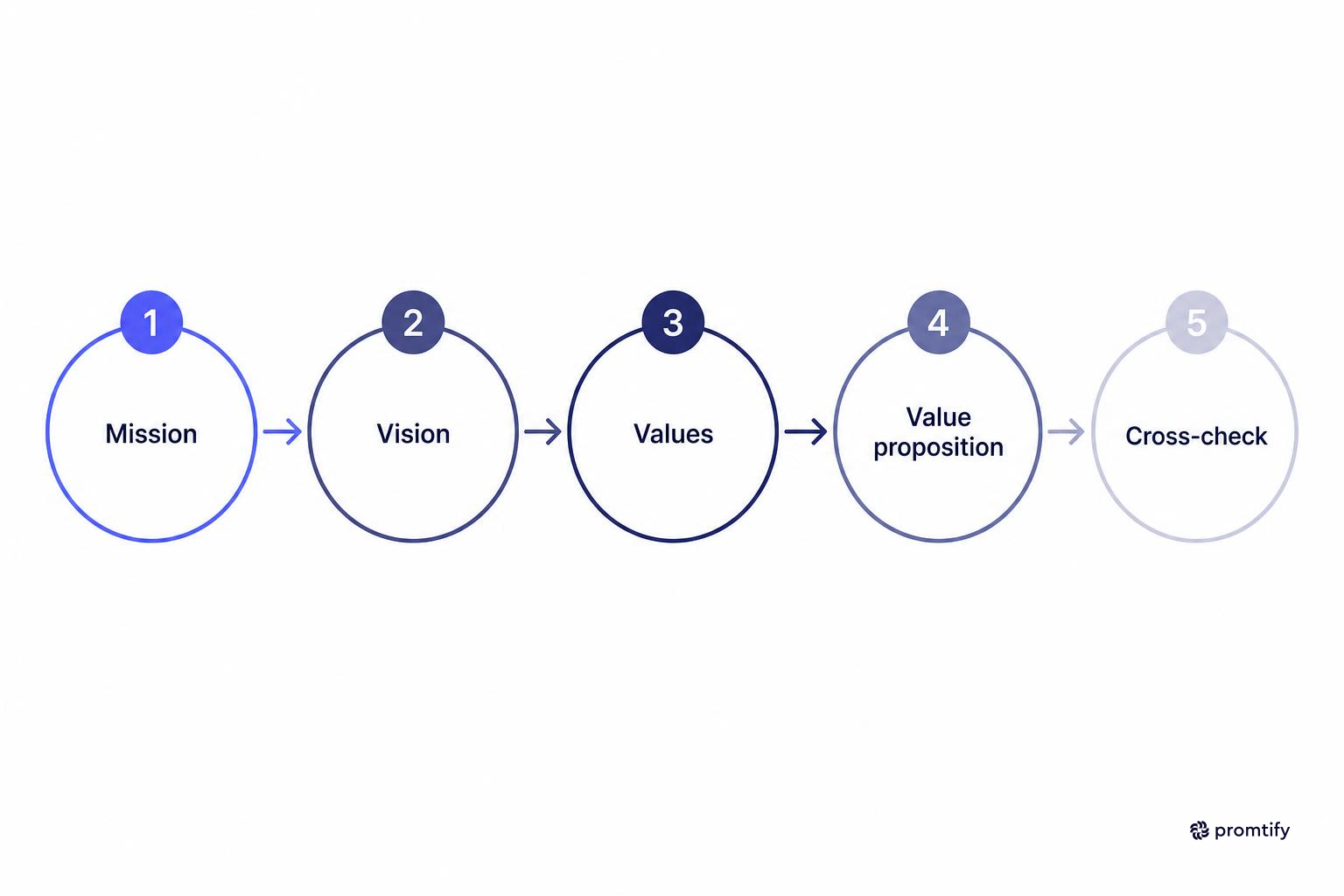
Writing mission, vision, value, and value proposition statements in isolation often leads to inconsistency. A structured process keeps them aligned. Working through the statements in the right order matters, because each later statement builds on the ones that came before it, and starting in the wrong place often produces documents that contradict each other.
- Define your mission first: Write one or two sentences describing why your company exists and what problem you solve. Avoid mentioning specific products, pricing, or competitors at this stage, and focus entirely on the underlying purpose that would remain true even if your product offering changed significantly.
- Draft your vision next: Describe the long-term future state your mission is working toward, written as an aspiration rather than a current action. Ask yourself what the world would look like if your mission succeeded completely, and let that answer shape the language of your vision statement.
- List your value statement principles: Identify three to five behavioral principles that guide decisions, avoiding generic buzzwords. For each principle, write a short explanation of what it looks like in a real decision, so the principle has practical meaning rather than existing as a decorative word.
- Write your value proposition last: Translate your mission and competitive strengths into a specific, customer-facing benefit statement. At this stage, allow yourself to reference specific product features, outcomes, and even indirect competitive comparisons, since this is the one statement in the group designed to persuade rather than simply describe.
- Cross-check for overlap: Confirm that no single statement duplicates the function of another, and that each one serves its distinct audience. Read all four statements out loud in sequence and ask whether each one adds new information, or whether any of them are simply restating what another statement already said in different words.
Using an AI Template to Draft These Statements Consistently
Writing four related but distinct statements by hand often results in repetition or contradiction between documents. An AI template can guide you through each statement type with targeted prompts, asking for your core purpose, your long-term goal, your guiding principles, and your customer benefit separately. Rather than facing a blank page and trying to write all four statements from memory, the structured prompts force you to answer one focused question at a time, which naturally keeps the statements from blending into one another.
This structured approach prevents the common error of writing a value proposition that sounds like a mission statement, or a vision statement that reads like a marketing slogan. By answering focused questions for each statement type, you end up with four documents that are distinct in function but aligned in voice. The template approach also helps teams that are revising existing statements rather than starting from scratch, since it gives everyone a shared structure to evaluate the current drafts against, rather than relying on subjective opinions about which version "sounds better."
Once you have drafted these statements, keeping the reasoning behind each one documented matters as much as the statements themselves. Promtify lets your team save the context behind these decisions, such as why certain words were chosen for the mission statement or which customer research shaped the value proposition, so the next person working on messaging does not have to start from scratch or guess at past decisions. This becomes especially valuable when a company goes through leadership changes or brings on a new marketing lead, since that person can review the documented reasoning rather than having to reverse-engineer the thinking behind each statement from scratch.
How to Test Whether Your Statements Are Working
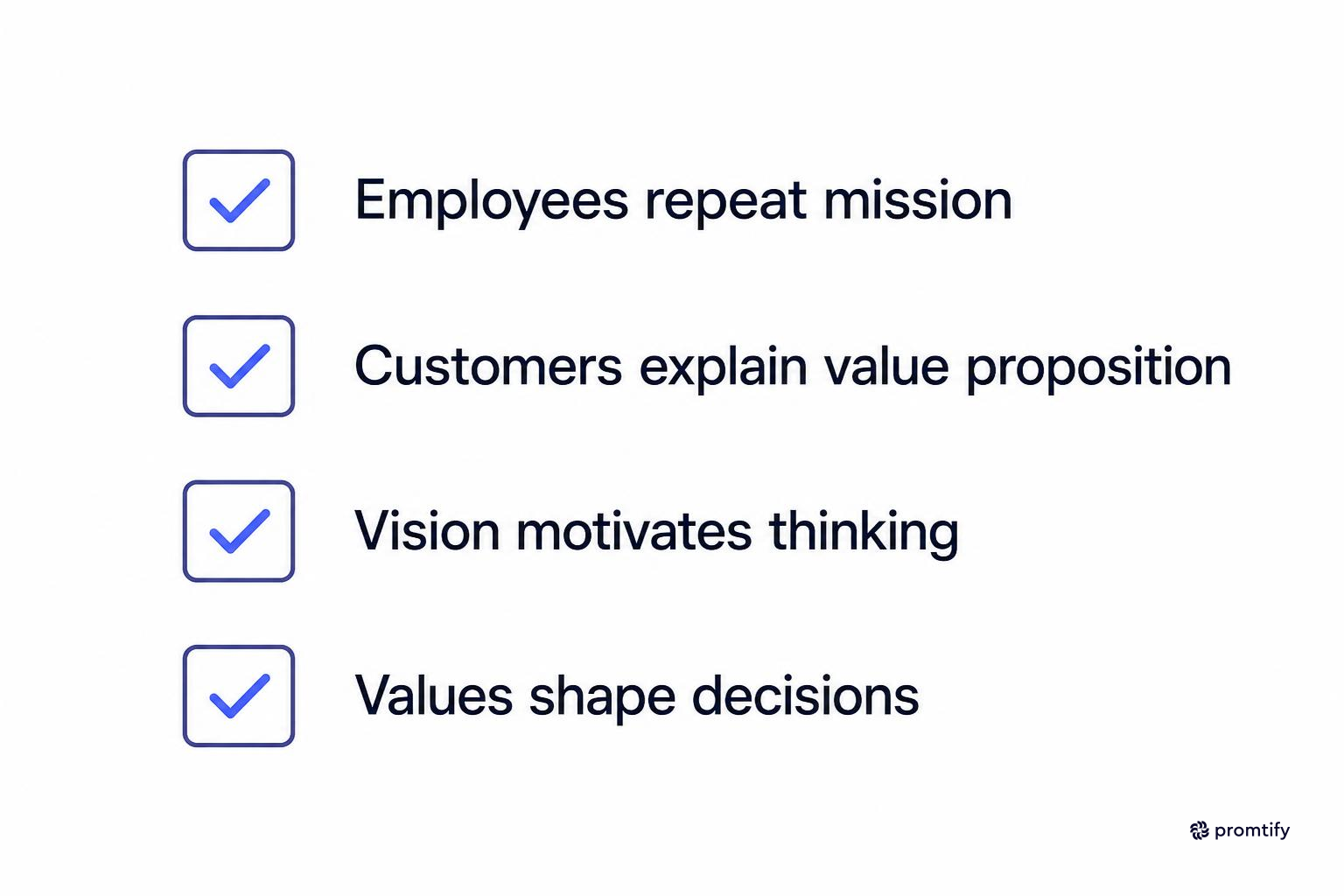
A mission statement works if employees can repeat it accurately and explain how their daily work connects to it. A value proposition works if a customer can state, in their own words, why your product solves their problem better than alternatives. These are not abstract tests; they can be run directly by asking a sample of employees or customers these exact questions and listening carefully to how well their answers match the intended meaning of each statement.
A vision statement works if it motivates long-term thinking without becoming so abstract that it feels disconnected from daily operations. A value statement works if you can point to a specific company decision and explain which principle influenced it. If a manager cannot recall a single instance where a stated value actually shaped a real decision, that value statement is likely functioning as decoration rather than as a genuine guide for behavior.
If any of these statements fail their test, such as customers being unable to explain your value proposition or employees being unable to recite your mission, it is a signal to revise that specific document rather than rewriting all four at once. Isolating the problem to a single statement, rather than assuming the entire messaging framework is broken, saves significant time and prevents unnecessary changes to statements that were actually working fine.
Keeping These Statements Aligned Across Teams
Marketing teams typically own the value proposition, while leadership or founders typically own the mission and vision statements. Without coordination, these statements can drift apart over time, especially as a company grows or pivots its product strategy. A marketing team might update the value proposition to reflect a new product launch without realizing that the underlying mission statement, still describing the company's original narrower purpose, no longer fully supports the direction the value proposition is now taking.
Regularly reviewing all four statements together, rather than editing them in isolation, helps maintain consistency. When your mission statement changes because of a strategic pivot, your value proposition should be reviewed to confirm it still reflects the updated purpose. Scheduling this review as a recurring exercise, rather than something that only happens reactively after a major strategic shift, helps catch small inconsistencies before they compound into a larger messaging problem.
Documenting the rationale behind each revision, including what prompted the change and which stakeholders approved it, helps future team members understand the evolution of your messaging. This is particularly useful when onboarding new marketing hires or briefing external agencies who need the full context quickly rather than piecing it together from old slide decks. A clear record of why a mission statement shifted from one phrasing to another, or why a particular value was added to the list, prevents future teams from accidentally reversing a deliberate decision simply because they were unaware it had been made intentionally in the first place.


